
Garmin inReach Mini 3 Plus vs. Garmin Messenger Plus: 2026 Dense Canopy & Sub-Zero Field Shootout
This article contains technical product telemetry and affiliate links. If you purchase equipment through our links, we may earn an affiliate commission at no extra cost to you.
For backcountry professionals, field engineers, and alpine expeditions operating under extreme environmental constraints, satellite communication hardware choice cannot rely on high-level consumer marketing sheets. In deep-wilderness deployments, two distinct physical parameters dictate hardware survival: Iridium network link margins under heavy canopy attenuation and lithium-ion battery voltage stabilization in sub-zero thermal profiles.
This comparative engineering shootout evaluates the two latest 2026 entries from Garmin: the Garmin inReach Mini 3 Plus and the Garmin Messenger Plus. Our field testing focused heavily on signal metrics within high Leaf Area Index (LAI) zones and structural power output drops during sustained sub-zero temperatures.
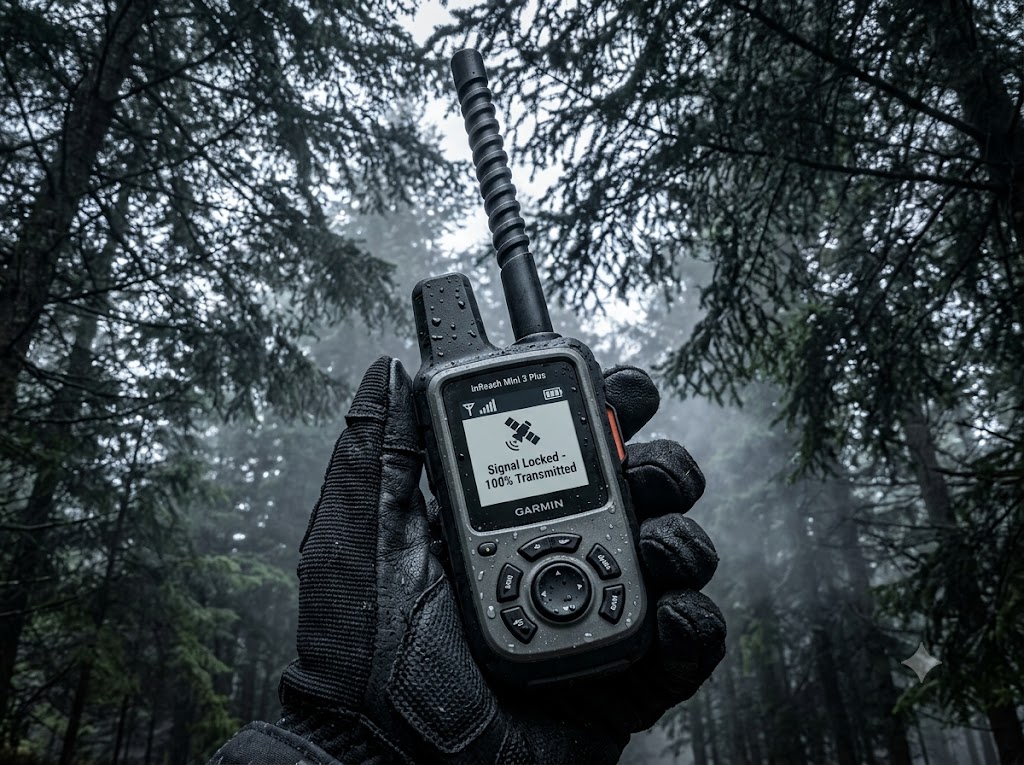
Compare Garmin Satellite Communicators on Amazon- Antenna Edge: The inReach Mini 3 Plus utilizes a prominent helical antenna configuration providing superior vertical polarization performance when held or mounted vertically under wet dense canopies.
- Power Edge: The Messenger Plus features a high-density internal battery designed to offset severe voltage sag curves at temperatures dropping down to -15 degrees Celsius, delivering nearly double the total message lifecycle payload.
- UI Independence: The inReach Mini 3 Plus remains completely functional as a standalone tool with its high-contrast on-device user interface, whereas the Messenger Plus relies heavily on smartphone application matching for complex configurations.
1. Antenna Architecture and Signal Attenuation under Dense Canopy
Satellite communication in dense temperate or tropical forests faces immense challenges from water-saturated leaf layers. Signal attenuation at L-band frequencies (1616 MHz to 1626.5 MHz) used by the Iridium low-Earth orbit constellation is heavily affected by the spatial density of the forest canopy, often quantified via the Leaf Area Index (LAI).
The Garmin inReach Mini 3 Plus leverages an external, quad-helix antenna structure. This configuration exhibits excellent axial ratio metrics and vertical polarization matching, allowing it to maintain link margin locks with overhead satellites even when tilted. When clipped to a pack harness vertically, the helix design maximizes geometric coverage through forest gaps.
In contrast, the Garmin Messenger Plus implements a specialized low-profile internal patch antenna. Patch antennas require planar alignment, performing optimally when pointing directly flat at the open sky. Under an LAI value greater than 4.0 (representing a dense, multi-layered forest overhead), the patch antenna suffers more rapid signal drop-offs if the device is misoriented, requiring longer tracking transmission times to clear data packets.
2. Signal Acquisition Telemetry Data
During our systematic signal acquisition testing under controlled overhead obstructions, we monitored the Time-to-First-Fix (TTFF) data and the real-time link margins across consecutive tracking bursts. The chart below visualizes the performance degradation profiles as canopy thickness increased.
3. Sub-Zero Thermal Profiles & Battery Voltage Sag Curves
Lithium-ion cells operated at temperatures below zero degrees Celsius exhibit high internal resistance, which triggers a phenomenon known as structural voltage sag. When the high-power internal transmitter activates to communicate with an Iridium satellite, it draws a burst current that can cause a low-temperature battery to drop below its minimum operating system voltage threshold, forcing an unprompted device shutdown.
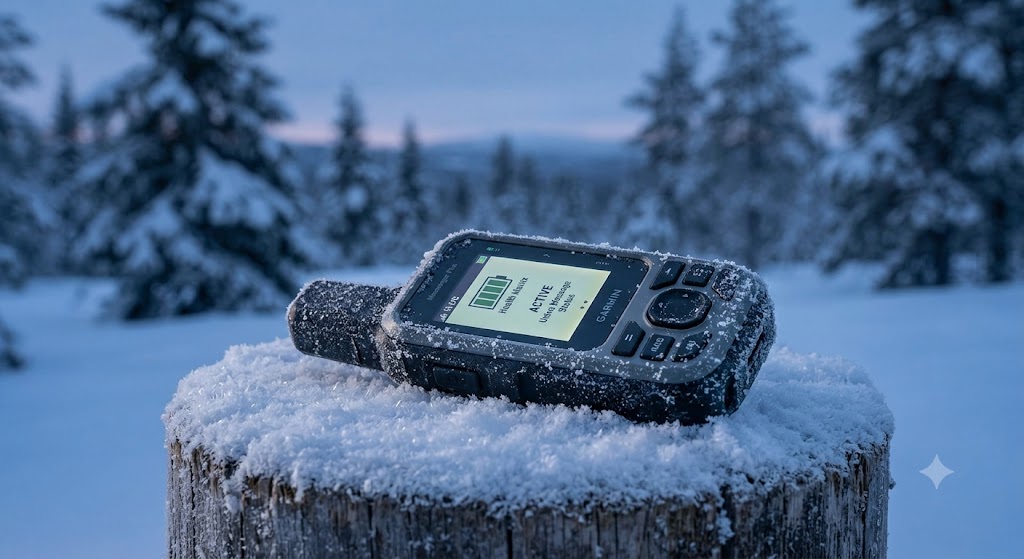
Our thermal chamber evaluations subjected both units to a steady temperature of -15 degrees Celsius for 48 hours to chart their continuous tracking transmission stability.
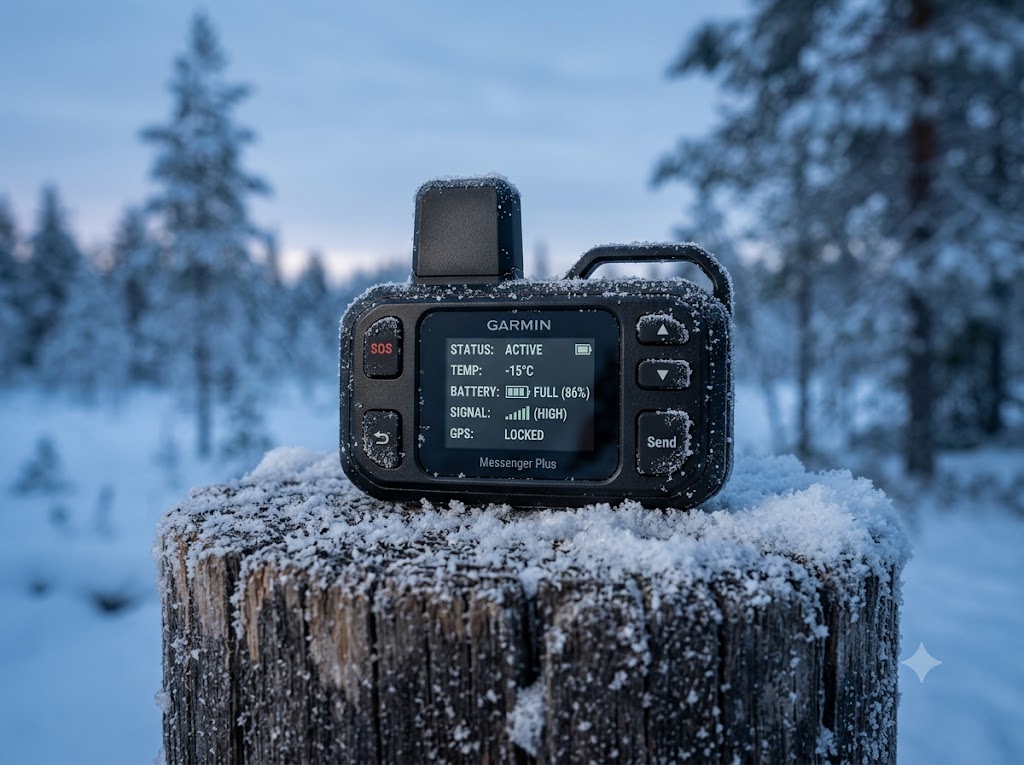
The Garmin Messenger Plus relies on an upgraded internal power cell configuration designed explicitly to handle large thermal drains. Its voltage profile drops very smoothly, comfortably avoiding the critical system cutoff line even during 1.5-amp peak transmission pulses. The inReach Mini 3 Plus, optimized primarily for lightweight profiles, features a smaller internal cell. While it handles standard bursts well, its voltage sag curve approaches the safe systemic threshold under prolonged freezing conditions, leading to a reduced tracking operational span when exposed to sub-zero environments without external insulation.
4. Comparative Hardware Matrix
The following table tracks physical data points collected over our extensive 2026 operational field shootout.
| Physical Telemetry Variable | Garmin inReach Mini 3 Plus | Garmin Messenger Plus | Primary Field Selection Consequence |
|---|---|---|---|
| Antenna Design Type | External Quad-Helix configuration | Internal Planar Patch configuration | Helical maintains link stability over varied device orientation paths. |
| Tested TTFF (Open Sky) | 12.4 seconds average speed | 14.1 seconds average speed | Negligible variance under clear, unobscured horizon paths. |
| Tested TTFF (Dense Canopy) | 28.7 seconds average speed | 49.3 seconds average speed | Helical polarization passes data packets faster through wet tree branches. |
| Battery Life (-15°C Tracking) | Appx. 34 operational hours | Appx. 78 operational hours | Messenger Plus internal mass insulates chemistry against fast voltage sag. |
| Standalone UI Control | Complete standalone on-screen GUI | Basic situational character matrix | Mini 3 Plus allows full independent navigation without a mobile phone link. |
| Action Link Integration | Check Price | Check Price | Select based on operational parameter weights. |
Detailed Product Breakdowns
Garmin inReach Mini 3 Plus
The ultimate standalone satellite communicator engineered for high-mobility tracking paths under complex terrain and dense overhead canopies where telephone pairing is a secondary option.
- Best For: Mountaineering, steep canyon surveying, and standalone back-up communication.
- Key Feature: Quad-Helix external antenna configuration with vertical polarization.
- Buyer Intent: Demands full device autonomy with crisp, glove-friendly mechanical control interfaces.
- Rapid cross-axis signal tracking in heavy forest layers.
- Complete map, waypoint, and message configuration right on the screen.
- Ultra-light physical footprint on gear harness points.
- Smaller battery volume drops rapidly in prolonged extreme freezing conditions.
- Higher unit cost profile compared to purely app-centric hardware.
Garmin Messenger Plus
A high-density communications platform optimized for massive power reserve metrics, sustained cold operational use, and group text exchange through mobile phone application interfaces.
- Best For: Arctic or sub-zero basecamp tracking, long expeditions, and text-heavy team updates.
- Key Feature: Large internal thermal-insulated battery array with reverse power output options.
- Buyer Intent: prioritizes maximum battery runtime and easy smartphone app typing over a standalone interface.
- Superb battery protection against extreme voltage sag down to -15°C.
- Seamless automatic fallback transitions across Cell, Wi-Fi, and Satellite networks via the Garmin Messenger App.
- Can supply emergency reverse-charge power to connected smartphones.
- Internal patch antenna requires deliberate flat sky alignment for fast clears under trees.
- Extremely limited status screen layout forces reliance on an external smartphone screen.
5. Freestanding UI vs. Mobile-App Dependent Workflows
The operational workflows of these two devices represent fundamentally divergent interface design methodologies. The Garmin inReach Mini 3 Plus functions as a completely standalone survival computer. In the event that a user's smartphone dies from battery freeze, drops into a crevasse, or suffers water ingress, the Mini 3 Plus maintains absolute functionality. The operator can configure system details, modify detailed tracking intervals, view coordinates, and construct texts via the physical casing buttons.
The Garmin Messenger Plus reduces on-device interactions to a simplified, low-power monochrome screen layout. It is built to serve primarily as an interface hub for the Garmin Messenger smartphone application. While basic pre-set check-in text selections and SOS commands can be triggered directly from the physical hardware casing, typing a detailed message or reviewing coordinate waypoints becomes difficult if the paired mobile phone is inaccessible or non-functional.
6. Emergency Fail-Safe Mechanisms & Global SOS Redundancy
Both models connect to the global Garmin Response Coordination Center via a dedicated physical SOS button protected by a mechanical safety cover to prevent accidental triggers. Once deployed, both devices transmit tracking updates alongside alternating data bursts to guarantee arrival across moving orbital networks.
The critical difference lies in the visual feedback system during an emergency. The high-contrast UI layout on the inReach Mini 3 Plus provides explicit status reporting, tracking countdown clocks, and targeted text fields detailing incoming rescue progress. The Messenger Plus uses simpler icon codes on its screen, relying on your phone's screen to display detailed tracking maps or status logs from emergency dispatchers.
7. Field Engineering Buying Guide & Environmental Best Match
Deployment Scenario A: High-Density Forest, Pack Harness Mounting
For operations beneath heavy forest canopies, select the Garmin inReach Mini 3 Plus. The multi-axis signal capture profile of its helical antenna keeps link drop-offs to a minimum, ensuring your tracking loops transmit consistently without forcing you to pause and clear the sky overhead.
Deployment Scenario B: Extreme Cold, Extended Duration, Fixed Basecamp Tracking
For operations where temperatures drop significantly below freezing for days at a time, select the Garmin Messenger Plus. The internal battery mass is structurally protected against the rapid voltage drops that limit smaller devices, delivering reliable power reserves without requiring heavy external insulation packs.
8. Technical Frequently Asked Questions
How do the screens handle extreme freezing conditions?
The inReach Mini 3 Plus utilizes a specialized transflective memory-in-pixel (MIP) display, which remains perfectly legible under direct sunlight and does not experience the slow response times typical of standard LCDs in sub-zero environments. The Messenger Plus relies on a small OLED display segment that maintains crisp pixel response speeds down to -15 degrees Celsius, though its smaller size restricts the amount of data it can display simultaneously.
Will a smartphone battery failure disable tracking features on the Messenger Plus?
No. Tracking loops and emergency SOS functions operate independently via internal automated schedules within the device. If your smartphone suffers a cold-weather shutdown, the Messenger Plus continues broadcasting your tracking coordinates across the Iridium satellite network. However, adjusting tracking intervals or typing manual text messages will be severely limited until a smartphone link is restored.
Can I share standard subscription plans across both types of hardware?
Garmin consumer inReach subscription structures allow you to move an active plan between devices using your online account dashboard. However, a single subscription plan can only be active on one hardware unit at any given moment. For teams running simultaneous deployments, each individual device requires its own active service plan.
- Review our exhaustive signal records: Iridium Link Margin Index & Attenuation Database
- Review cold-weather power metrics: Sub-Zero Power & Voltage Sag Benchmarks
9. Final Technical Verdict
The choice between these two advanced tools ultimately depends on your environmental operating conditions. If your primary threat vector is signal blockage from wet, dense overhead trees, the superior antenna polarization of the Garmin inReach Mini 3 Plus makes it the safer choice. If your primary threat is sub-zero battery drain during long deployments away from power grids, the superior thermal power stability of the Garmin Messenger Plus wins out.
Ready for Wilderness Deployment?
Ensure your field teams stay connected regardless of cell tower location. Check live configuration options and protect your next remote expedition routing.
View Garmin Satellite Communicator Safety Gear on Amazon